
Neurocontextual Systems Design
Coaching Certification & Mentoring Programs
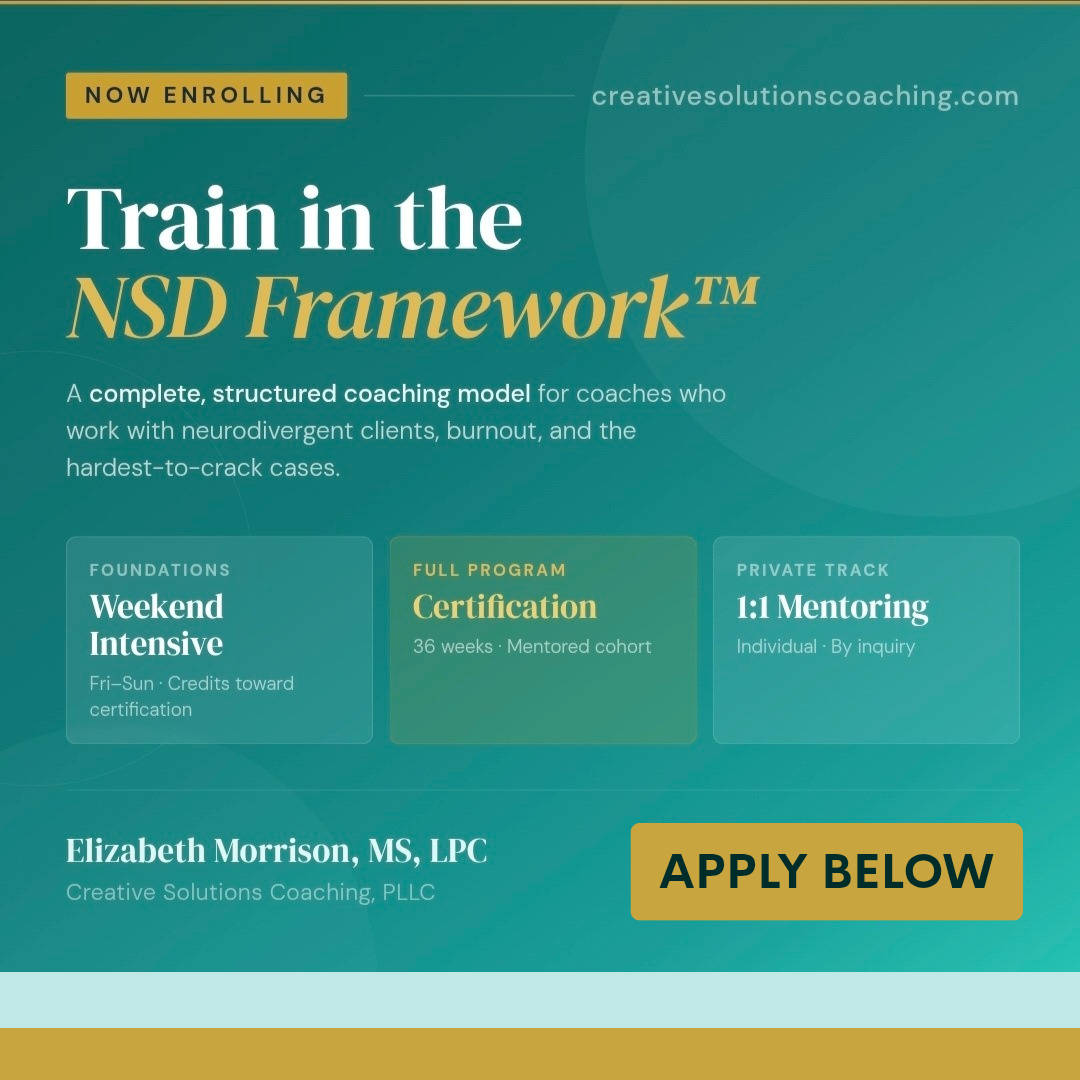
A complete, structured coaching model for coaches who work with neurodivergent clients, burnout, and the hardest-to-crack cases. Finally — a systematic way to find the mismatch and design the fix.
Most of the struggles neurodivergent people face aren't character flaws. They're mismatches between how their brain works and how their environment is set up.
The NSD Framework gives coaches a rigorous, repeatable way to identify those mismatches and design practical, lasting change — without crossing into clinical territory. Change the environment. Change the outcome.
6 Core Principles
NSD is built on a coherent theory of why neurodivergent people struggle — and what actually moves the needle.
Everything Is Connected
Neurology, self-narrative, and environment all affect each other. Small targeted changes create meaningful ripple effects.
Distress Follows Mismatch
Anxiety, burnout, and exhaustion are downstream effects of sustained environmental mismatch — not personal failures.
Capacity Is Real & Variable
Cognitive, emotional, sensory, and physical reserves fluctuate. Capacity is not willpower — it's a finite, real resource.
Thresholds Matter
When demands consistently exceed capacity, collapse happens suddenly, not gradually. Intervene before the threshold is reached.
Everything Constrains Everything
Biology, environment, and learned patterns all limit and enable each other. Surface-level fixes don't stick without whole-system design.
Experience Becomes Pattern
Years of mismatch teach people to interpret struggle as inadequacy. NSD reframes it — without requiring therapeutic excavation of the past.
The Mismatch–Overload–Distress Cycle
Understanding this three-stage progression is the foundation of every NSD intervention. Treat the mismatch — not the symptom.
Mismatch
The environment demands what a person's neurology can't sustainably deliver — sensory load, cognitive demands, social performance. The system begins to deplete.
Overload
Sustained mismatch depletes capacity faster than it refills. The system runs on deficit. Small things feel huge. Errors increase. Threshold lowers.
Distress
Chronic overload produces burnout, anxiety, relationship conflict, inability to function. Real effects — but downstream of the mismatch. Address the source, not the symptom.
The coaches who need this
NSD was built for coaches navigating the cases that don't respond to standard approaches.
🧠 Coaches working with neurodivergent clients
Autistic adults, ADHDers, and late-diagnosed individuals navigating work, relationships, and daily life.
🔥 Burnout & chronic overwhelm specialists
Clients experiencing collapse from years of environmental mismatch — not just stress, but system-level depletion.
🗂️ Coaches who want a structured model
A complete, repeatable framework — not intuition-based. Assessment tools, intervention domains, clear scope of practice.
⚡ Coaches frustrated by surface-level fixes
When habit stacks and mindset work aren't enough. NSD addresses why: the system isn't designed for this brain.
🔍 Helping professionals expanding into coaching
Social workers, counselors, and educators who coach — and want clarity on the coaching side of the work.
🌿 Coaches who want to go deeper, not wider
Fewer generic tools, more systematic expertise. NSD gives you a specialty you can build an entire practice around.
Six Intervention Domains
The curriculum teaches you to identify mismatch across all six domains and design targeted, realistic changes in each one.
Workplace & School Accommodation
Map the functional barrier precisely. Identify the specific change needed. Coach the request — informal first, formal when needed. Build scripts, prepare for pushback.
Sensory Environment Modification
Assess all modalities: auditory, visual, tactile, olfactory, proprioceptive. Tiered approach: what the client controls now → modest investment → formal accommodation.
Demand Reduction
Full demand audit across all life domains. Help clients distinguish essential from habit-driven. Scaffold the actual letting go — intellectual acknowledgment isn't enough.
Schedule Restructuring
Use 2–4 weeks of capacity tracking data. Align complex work with high-capacity windows. Build buffer time — the task-switching tax is real and higher for neurodivergent people.
Household & Relationship Redesign
Make invisible cognitive labor visible. Use domain-based ownership rather than 50/50 task splits. Eliminate coordination overhead. Involve partners directly when needed.
Communication & Self-Advocacy
Runs through all domains. Script the ask. Role-play before the field. Map pushback categories. Build follow-up language. Follow through on implementation.
Choose Your Training Path
Three ways to train in the NSD Framework™ — from a foundational weekend to full certification to individualized mentoring.
Weekend Intensive
- Full NSD Framework overview
- Core Mechanism & 6 Principles
- Introduction to the 6 domains
- Capacity assessment tools
- Scope of practice clarity
- Credits apply to full certification
Certification
- Complete NSD framework training
- All 6 intervention domains in depth
- NFMS-C: 8 fit domains assessment
- Case consultation & supervision
- Live cohort with peer learning
- Client tools & session templates
- Scope of practice framework
- Full certification upon completion
1:1 Mentoring
- Fully individualized training
- Pace and focus set by you
- Deep case consultation
- Practice-building support
- Direct access to E. Morrison
- Flexible scheduling
Know the Boundary
NSD training includes rigorous scope of practice education. You'll know exactly what falls inside coaching — and when to refer out.
- Present and future focus
- Identifying current mismatch
- Designing practical changes
- Education about neurodivergence
- Capacity awareness and management
- Systems-level problem solving
- Advocacy support
- Processing the past
- Diagnosing mental health conditions
- Treating psychiatric conditions
- Trauma therapy or EMDR
- Grief processing
- Identity excavation & narrative repair
- Medication management
Elizabeth Morrison developed the Neurocontextual Systems Design framework after years of recognizing a critical gap: neurodivergent clients weren't failing at life — their environments were failing to fit their neurology. Standard coaching models weren't built for this.
The NSD Framework™ is the result: a structured, science-based coaching model grounded in person-environment fit research, designed to give coaches a repeatable system for identifying mismatch and building practical, lasting change.
As both a licensed professional counselor and a credentialed coach, Elizabeth brings rigorous clinical grounding with an unwavering commitment to coach scope of practice. The framework is precise about the line between coaching and therapy, and trains coaches to navigate it with confidence.
Before You Apply
Ready to design coaching that actually fits the brain?
Fill out the form below and Elizabeth will be in touch personally to talk through next steps and find the right path for you.
© 2026 Elizabeth Morrison · Creative Solutions Coaching, PLLC