
Creative Insights
Understanding Unmasking
Masks are worn on the outside to hide or soften what feels “different” from those around us. This is common among neurodivergent people and others with disabilities.
Understanding your own unique abilities and challenges, or those of someone you support, opens the door to embracing differences and finding accommodations, adaptations, and skills that actually fit.
What Is Interoception?
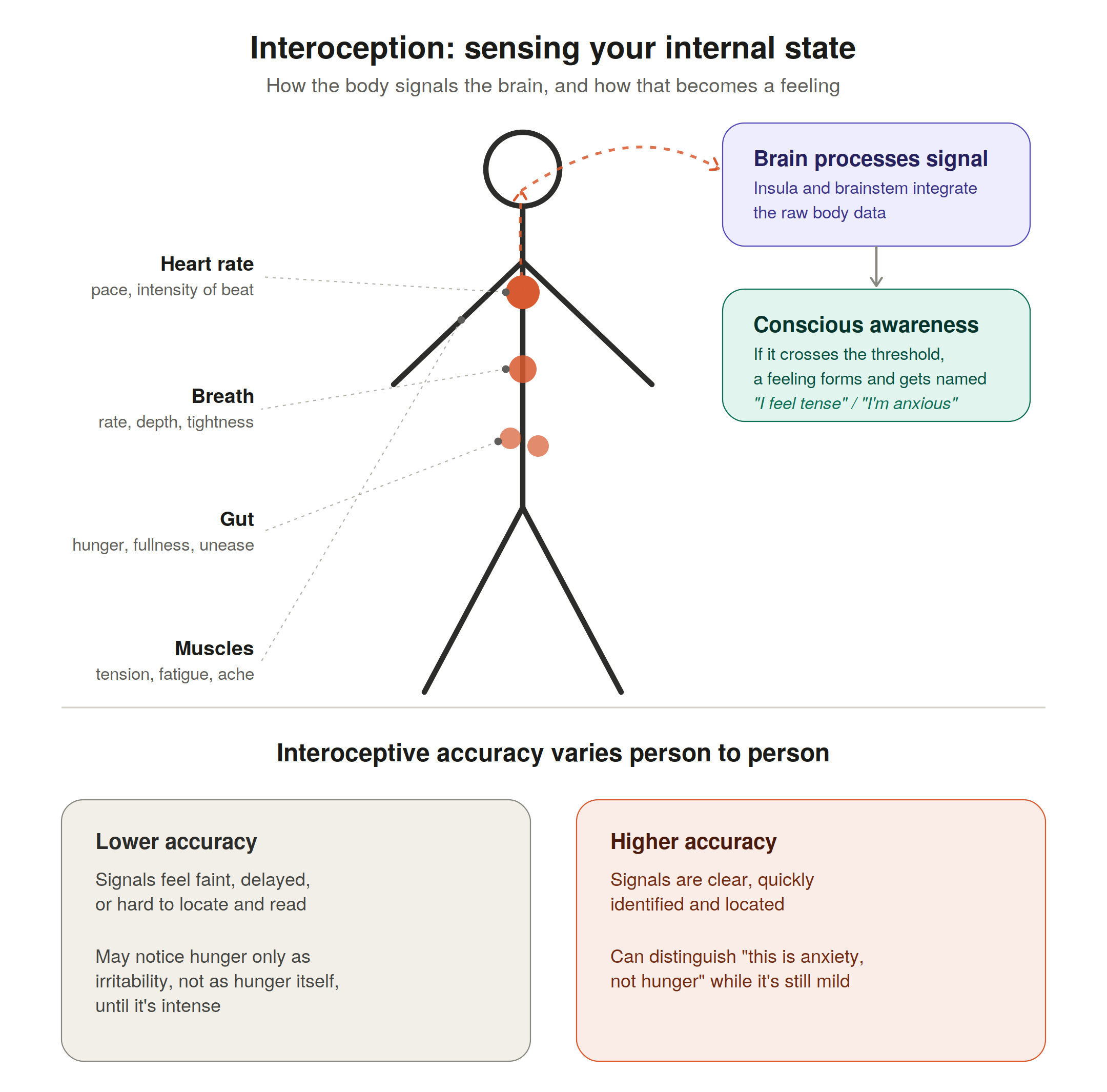
You were taught about five senses in school. Sight, hearing, smell, taste, touch. Maybe you got a bonus lesson on proprioception, which is the sense of where your body is in space, like knowing your arm is raised even when your eyes are closed. And maybe, if you were lucky, someone mentioned vestibular sense, which is balance and movement through space. But interoception? Almost nobody learns about interoception in school. And it might be the most important one.
What Burnout Actually Is
The clinical definition of burnout has three components: exhaustion, cynicism, and reduced efficacy. Those three describe the end state. They do not describe what produces it, which is where the useful information lives.
Why Meetings Exhaust Some People and Not Others
A ninety-minute block in your calendar with two thirty-minute meetings in it does not contain forty-five minutes of usable focused work. For some people it does, or close to it. For others it contains something more like fifteen minutes of fragmented time that is difficult to use for anything requiring sustained concentration.
You Can Be Good at a Job and Still Not Be Able to Keep Doing It
Most careers include at least one role that looked right, felt right in the interview, and then slowly became something the person could not sustain. The work was not too hard. They were capable of it. The structure around it was incompatible with how they actually function, and that incompatibility built across months in ways that were difficult to name until they became impossible to ignore.
Rejection Sensitivity
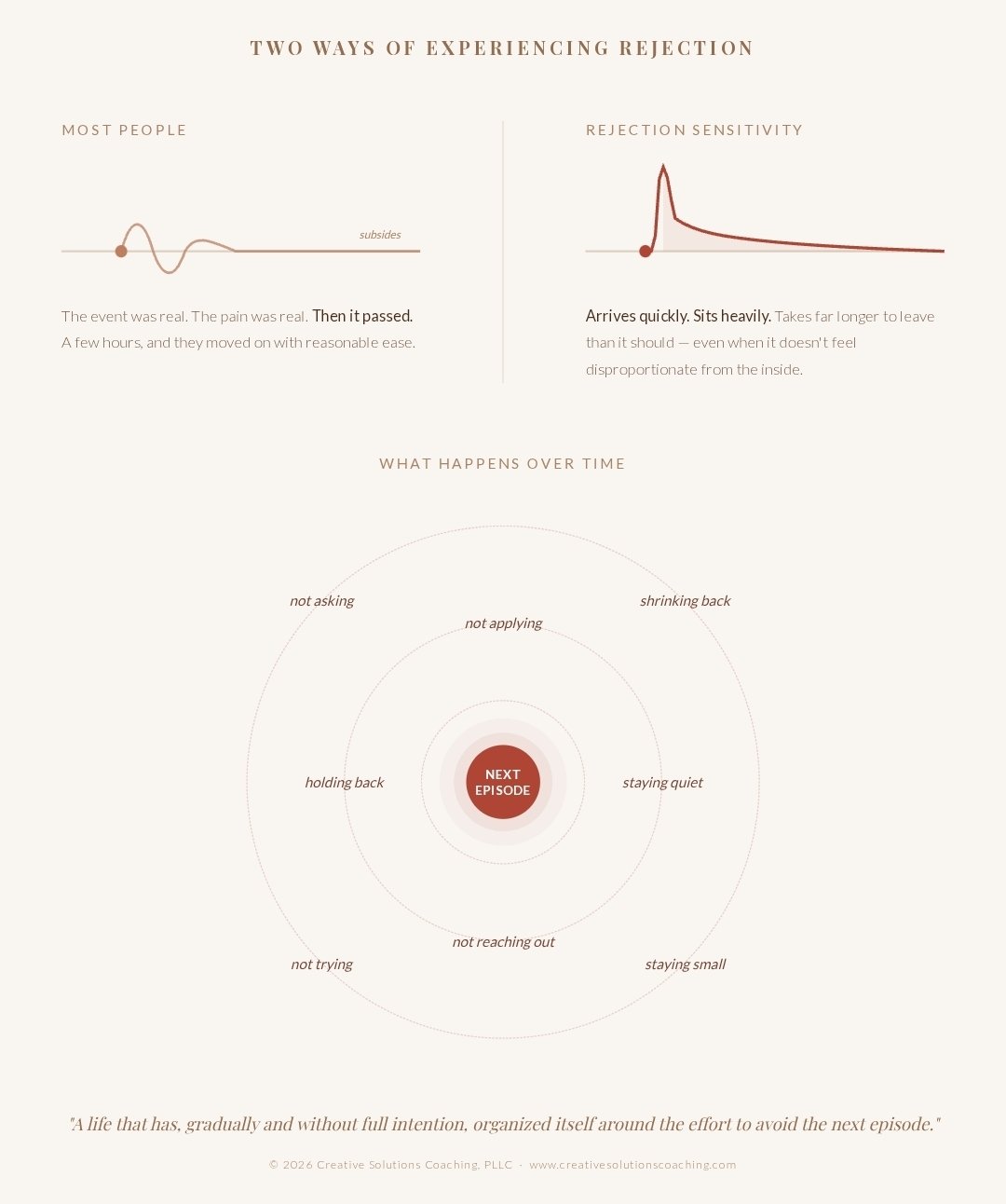
The science of rejection sensitivity and why certain nervous systems register social pain with an intensity that can stop the day cold.
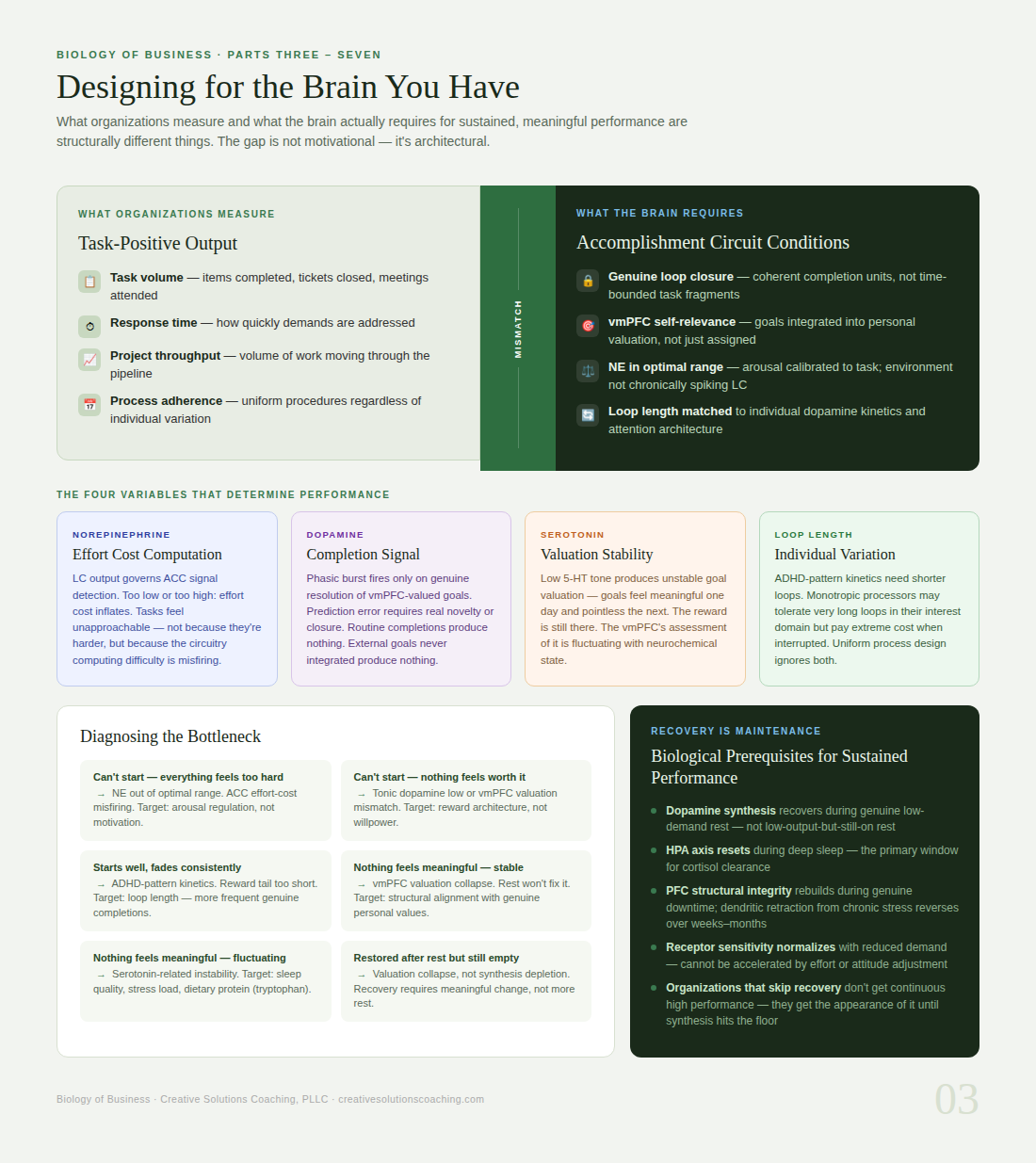
The Neuroscience of Accomplishment vs. Productivity
Why your brain tracks whether something mattered, not how much you did.
Most productivity frameworks get this wrong: the brain does not measure output. It does not tally tasks completed, hours logged, or items checked off a list. What the brain measures is whether something resolved -- whether a loop closed, whether the effort had a point.
That distinction is not semantic. It is neurological. And understanding it changes how you think about performance, motivation, burnout, and the design of work itself.
Two systems that most people treat as one -- productivity and accomplishment -- share some circuitry, but they are not the same thing, they do not produce the same neurochemical response, and optimizing for one can actively undermine the other.
What follows is how these systems work, what drives them, and what happens when the environment is built around the wrong one.
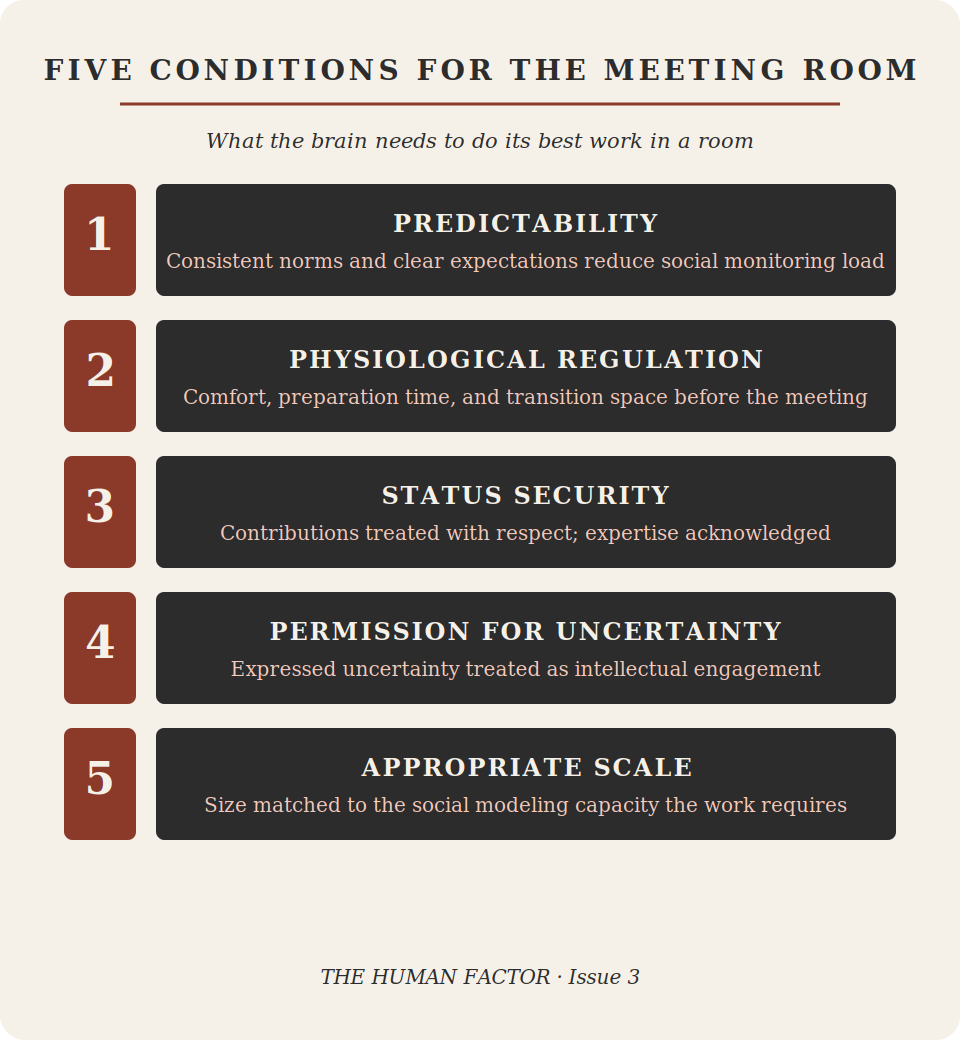
The Meeting Room as Neurological Environment
Before the first agenda item is introduced, the meeting has already begun, at a level considerably below conscious awareness.
The brain enters a room the way it enters any social environment: in a state of active assessment. Who is here. Where they sit. How they hold themselves. Who looks at whom and for how long. What the emotional temperature is. Where the power lives. This assessment runs automatically, in milliseconds, drawing on neural systems that predate language by hundreds of millions of years. By the time someone says good morning, the social brain has already generated a working model of the room.
A meeting is one of the most neurologically demanding environments the modern workplace produces. It concentrates, in a single space and time window, the specific combination of inputs the social brain is most sensitive to: live status dynamics, real-time performance evaluation, simultaneous prediction across multiple people, and meaningful consequences attached to how things go. The brain takes all of this seriously. It allocates resources accordingly.
Understanding what the brain is doing in that room, mechanistically and specifically, changes how leaders design meetings, how managers read their teams, and how individuals understand their own behavior in group settings. The neuroscience of the meeting room is the neuroscience of human social cognition under conditions that matter.