
Creative Insights
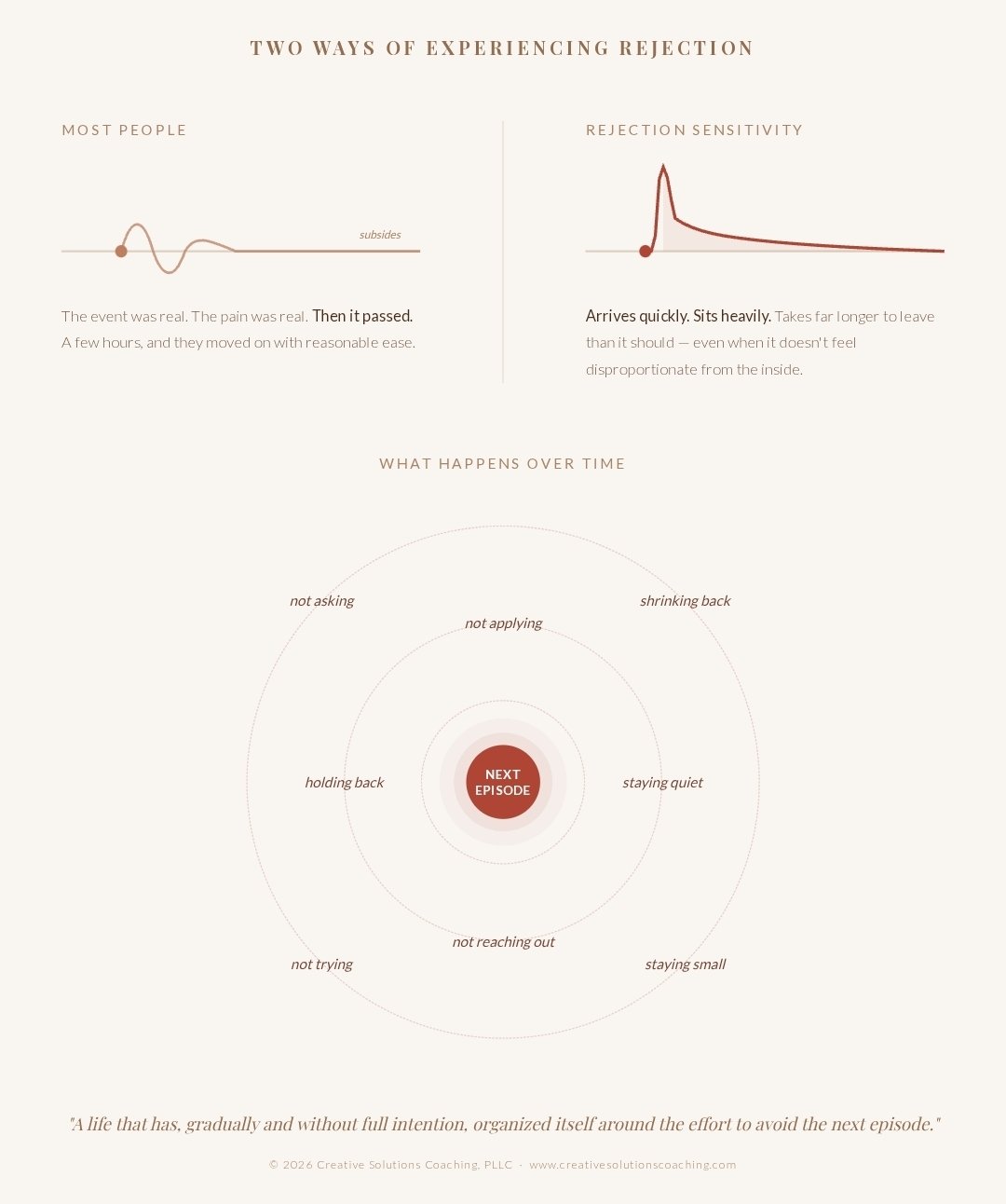
Rejection Sensitivity
The science of rejection sensitivity and why certain nervous systems register social pain with an intensity that can stop the day cold.
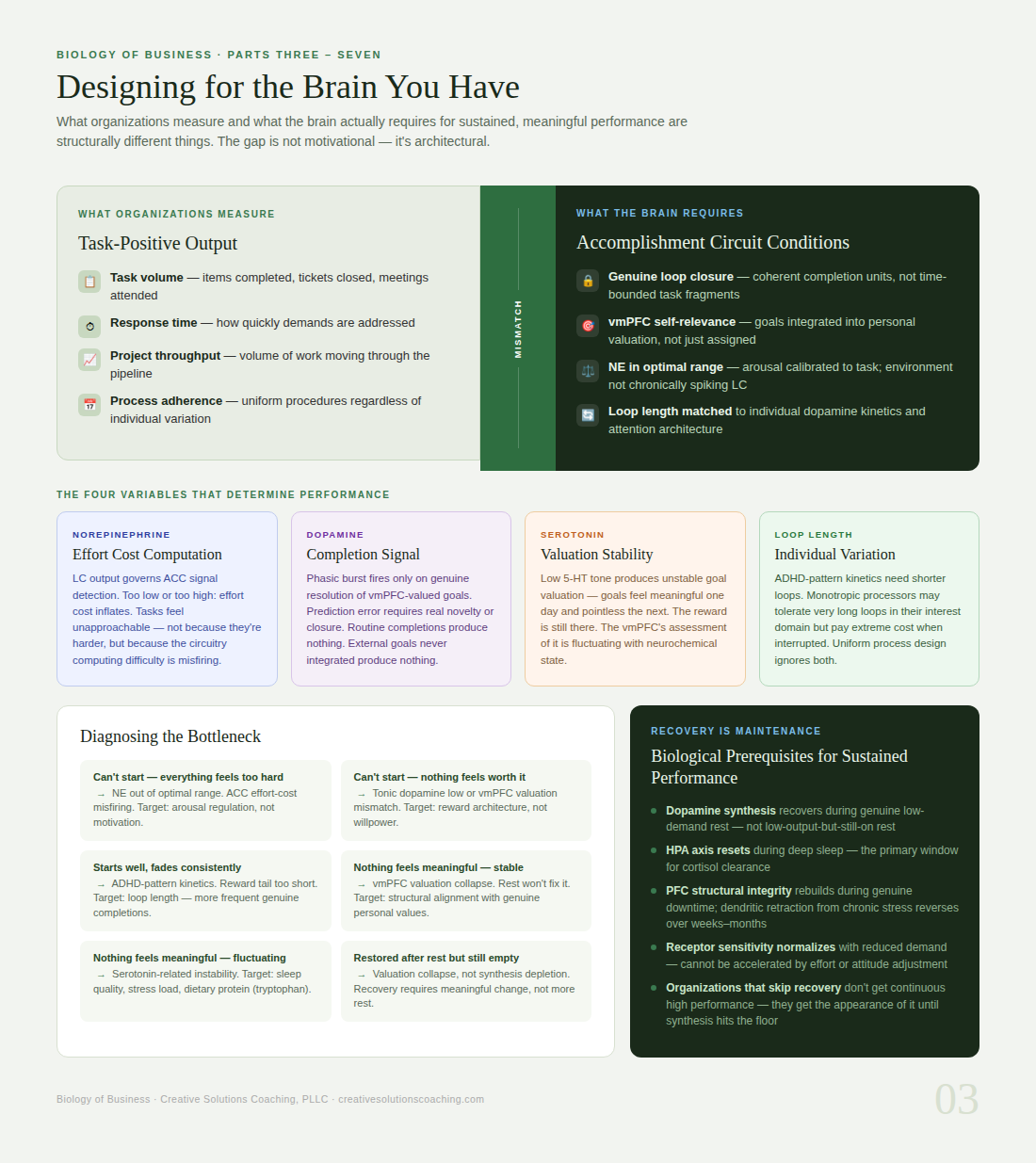
The Neuroscience of Accomplishment vs. Productivity
Why your brain tracks whether something mattered, not how much you did.
Most productivity frameworks get this wrong: the brain does not measure output. It does not tally tasks completed, hours logged, or items checked off a list. What the brain measures is whether something resolved -- whether a loop closed, whether the effort had a point.
That distinction is not semantic. It is neurological. And understanding it changes how you think about performance, motivation, burnout, and the design of work itself.
Two systems that most people treat as one -- productivity and accomplishment -- share some circuitry, but they are not the same thing, they do not produce the same neurochemical response, and optimizing for one can actively undermine the other.
What follows is how these systems work, what drives them, and what happens when the environment is built around the wrong one.
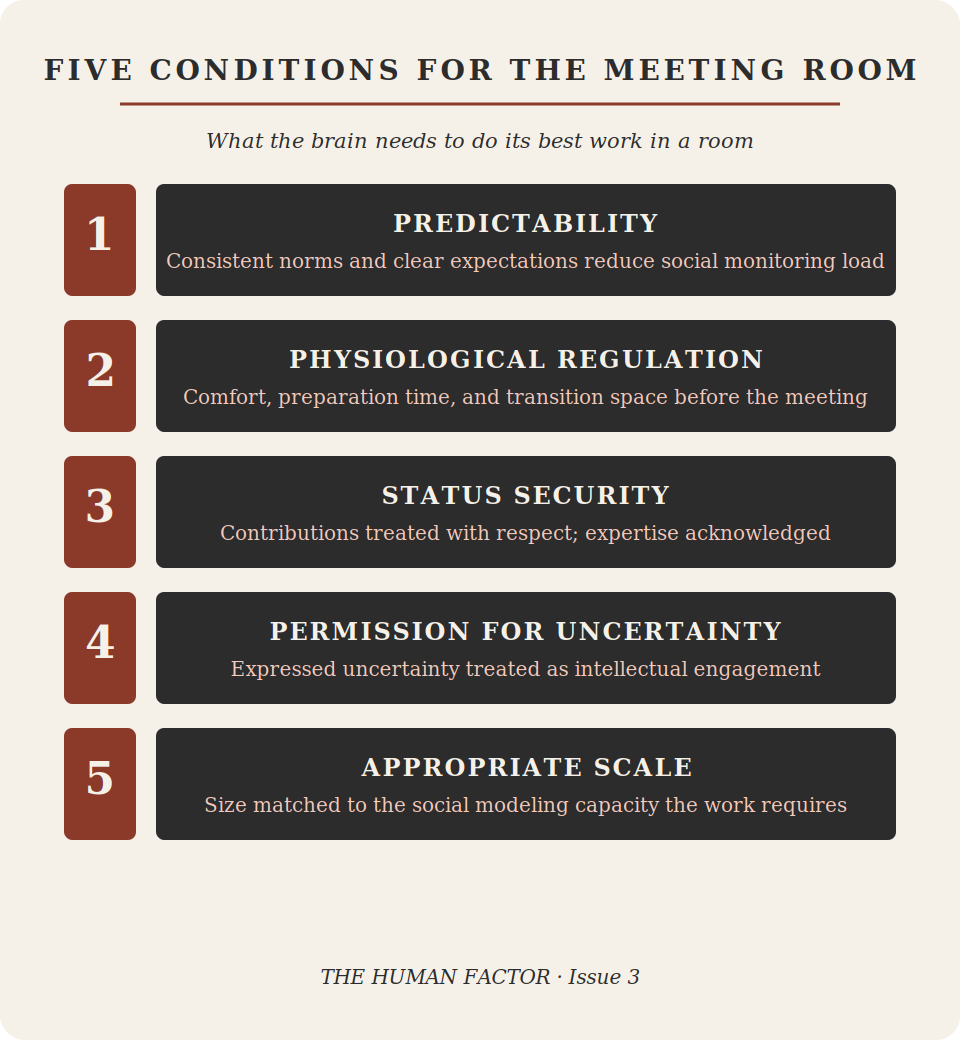
The Meeting Room as Neurological Environment
Before the first agenda item is introduced, the meeting has already begun, at a level considerably below conscious awareness.
The brain enters a room the way it enters any social environment: in a state of active assessment. Who is here. Where they sit. How they hold themselves. Who looks at whom and for how long. What the emotional temperature is. Where the power lives. This assessment runs automatically, in milliseconds, drawing on neural systems that predate language by hundreds of millions of years. By the time someone says good morning, the social brain has already generated a working model of the room.
A meeting is one of the most neurologically demanding environments the modern workplace produces. It concentrates, in a single space and time window, the specific combination of inputs the social brain is most sensitive to: live status dynamics, real-time performance evaluation, simultaneous prediction across multiple people, and meaningful consequences attached to how things go. The brain takes all of this seriously. It allocates resources accordingly.
Understanding what the brain is doing in that room, mechanistically and specifically, changes how leaders design meetings, how managers read their teams, and how individuals understand their own behavior in group settings. The neuroscience of the meeting room is the neuroscience of human social cognition under conditions that matter.
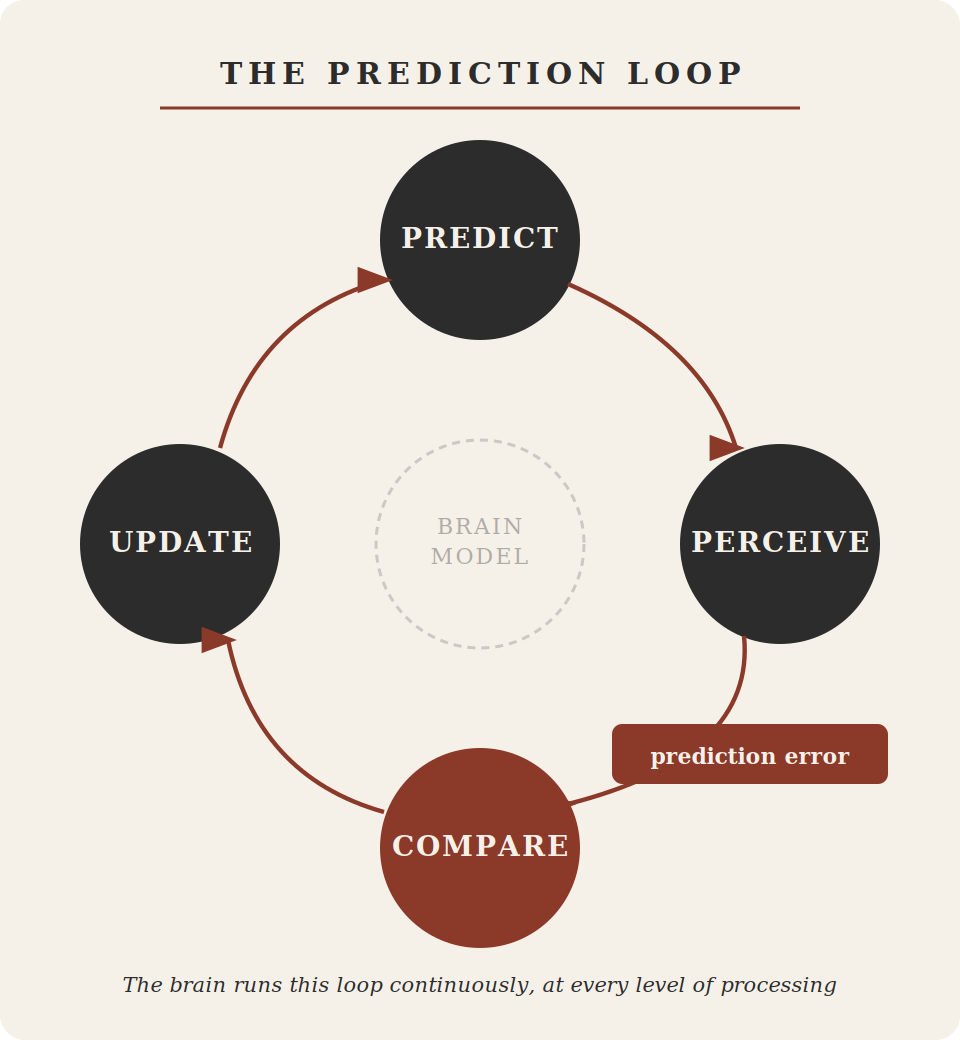
The Prediction Machine
Before a word reaches conscious awareness, before a face resolves into recognition, before a decision presents itself as a choice, the brain has already generated a prediction about what is coming. It does this continuously, automatically, and at every level of processing — from the raw assembly of sensory data into perception, all the way up to the high-level expectations that shape how a leader reads a room or how a team interprets a change in strategy.
Your Brain Was Not Built for This
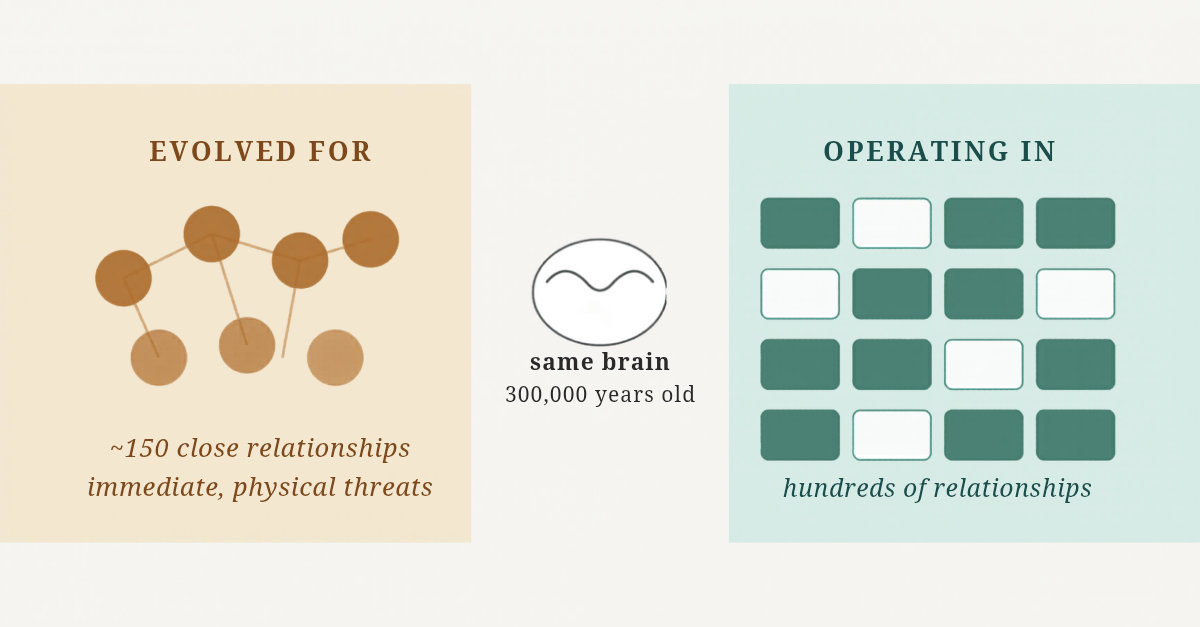
Sometime around 300,000 years ago, give or take, the brain you are using to read this sentence finished its last major hardware update. What you have in your skull right now — the roughly three-pound organ responsible for your quarterly targets, your Slack hygiene, your inability to stop checking your phone during meetings, your best ideas, your worst decisions, and your persistent sense that something is slightly wrong — is the same basic architecture that helped your ancestors track prey across open savanna, navigate complex social hierarchies around a fire, and survive in environments that were actively trying to kill them.
Building a Life That Does Not Require Burnout to Function
After burnout, most people spend months or years in recovery. They rest. They reduce demands. They slowly rebuild capacity. And then they face a choice: do they return to the life that caused burnout, hoping they can manage it better this time? Or do they build something different?
Many people choose the first option because it feels easier. The systems were already in place. The routines were established. Going back seems simpler than starting over. But going back recreates the conditions that caused collapse. Within months — sometimes weeks — the cycle restarts.
The way to break this pattern is not managing the old life better. It is building a new life that fits the nervous system you actually have. This is not about lowering expectations or giving up on goals. This is about designing systems that work with your neurology instead of against it.
Workplace Survival for Autistic Adults
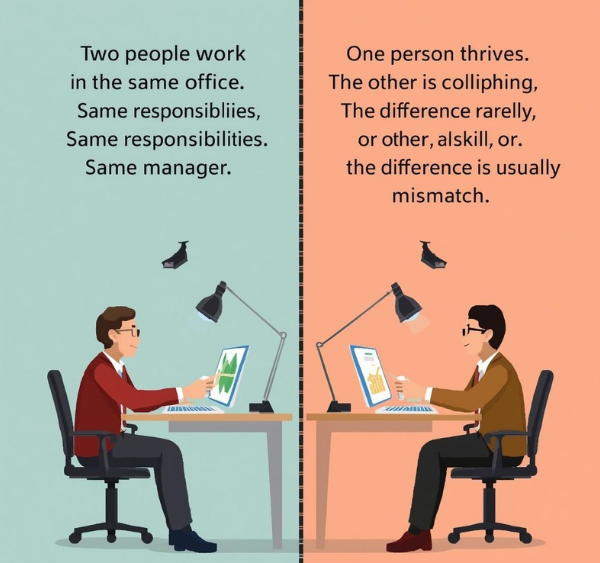
Two people work in the same office. Same role. Same responsibilities. Same manager. One person thrives. The other is collapsing. The difference is rarely effort, skill, or commitment. The difference is usually mismatch.
For autistic adults, workplaces are often designed in ways that create chronic overload. Open office plans. Constant interruptions. Unclear expectations. Rapid task-switching. Social demands layered on top of technical work. Fluorescent lighting. Background noise. Meetings that could have been emails. None of these are inherently problems. They become problems when they exceed what a nervous system can sustainably handle.
For neurotypical employees, these conditions may be annoying but manageable. For autistic employees, they can be the difference between functioning and burnout. This is not about being less capable. This is about environments that do not match neurological needs.
Burnout at work is not personal failure. It is environmental mismatch. When the environment changes, functioning can improve. When it cannot change, leaving is self-preservation — not defeat.
Recovering From Autistic Burnout: Structural Change, Not Just Rest
Recovery from autistic burnout is not about getting back to normal. It is about building a new normal that matches capacity rather than overriding it. This takes time. It takes support. It takes structural change. And it takes releasing the belief that struggling means failing.
First: Reduce & Rest
Lower demands to absolute minimum. This is triage, not failure.
Then: Grieve & Rebuild
Do both pathways simultaneously — environmental and narrative.
Always: Change the Conditions
Returning to what caused burnout recreates it. Structural change is permanent.