
Creative Insights
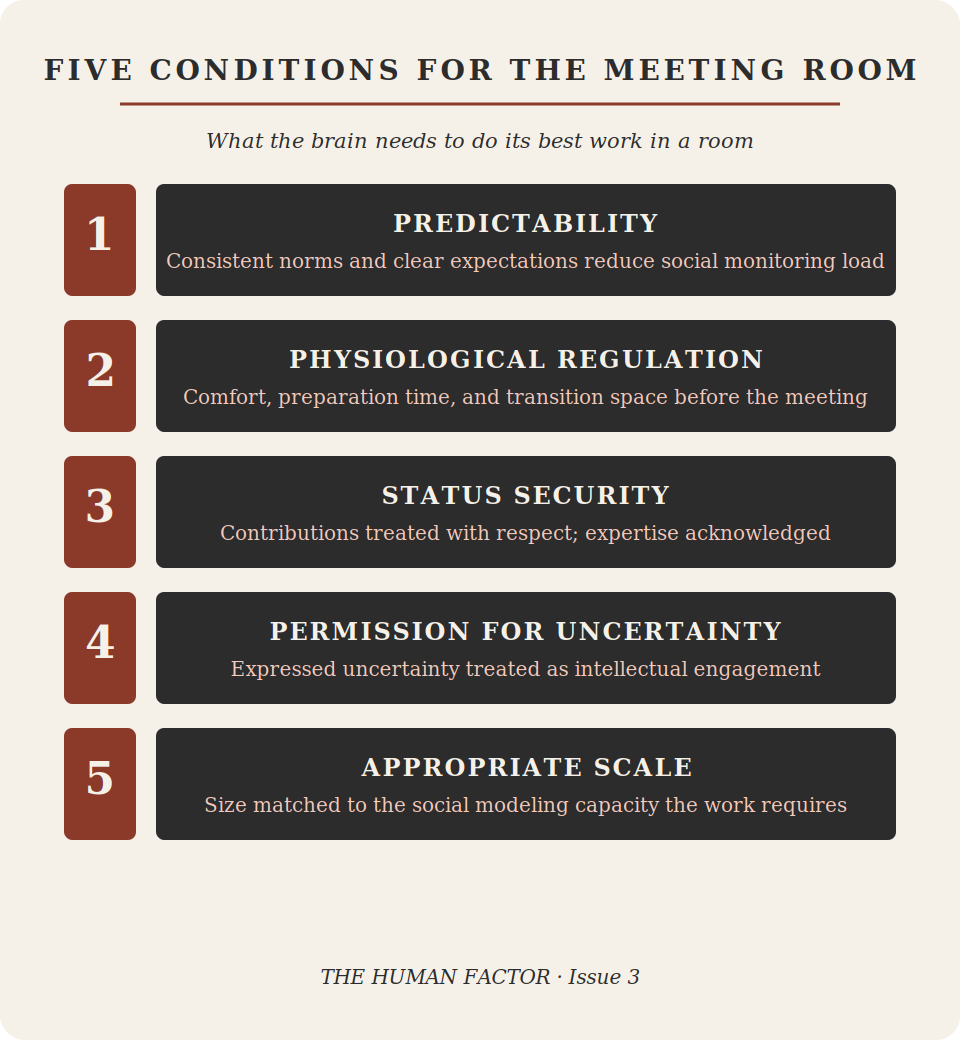
The Meeting Room as Neurological Environment
Before the first agenda item is introduced, the meeting has already begun, at a level considerably below conscious awareness.
The brain enters a room the way it enters any social environment: in a state of active assessment. Who is here. Where they sit. How they hold themselves. Who looks at whom and for how long. What the emotional temperature is. Where the power lives. This assessment runs automatically, in milliseconds, drawing on neural systems that predate language by hundreds of millions of years. By the time someone says good morning, the social brain has already generated a working model of the room.
A meeting is one of the most neurologically demanding environments the modern workplace produces. It concentrates, in a single space and time window, the specific combination of inputs the social brain is most sensitive to: live status dynamics, real-time performance evaluation, simultaneous prediction across multiple people, and meaningful consequences attached to how things go. The brain takes all of this seriously. It allocates resources accordingly.
Understanding what the brain is doing in that room, mechanistically and specifically, changes how leaders design meetings, how managers read their teams, and how individuals understand their own behavior in group settings. The neuroscience of the meeting room is the neuroscience of human social cognition under conditions that matter.