 Image 1 of 1
Interpersonal Communication Skills Handbook: NSDS Interactive
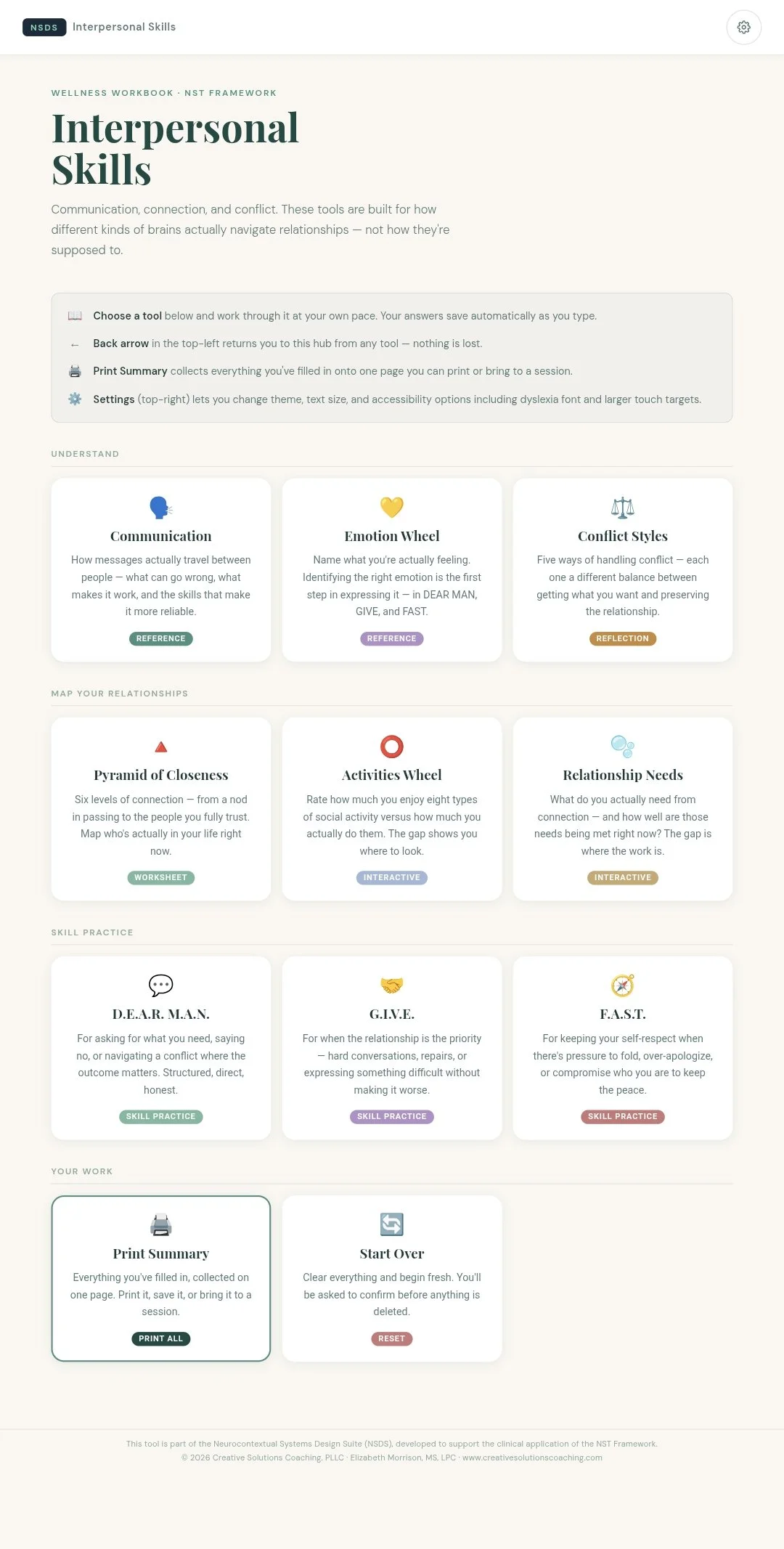
Interpersonal
Skills
Tools for understanding how communication works, mapping your relationships, and practising the skills that make connection more reliable — built specifically for neurodivergent experience.
🔍 You're exploring the Demo Version
Communication, Emotion Wheel, and Conflict Styles are fully active. The full licensed version adds all 7 locked tools:
- Pyramid of Closeness — six levels of connection; map who's actually in your life right now
- Activities Wheel — rate enjoy vs. doing for 8 social activity types; see the gap
- Relationship Needs — rate importance and how met for 10 core needs; gap chart + interpretation
- D.E.A.R. M.A.N. — structured worksheet for asking for what you need or navigating conflict
- G.I.V.E. — worksheet for when the relationship is the priority
- F.A.S.T. — worksheet for keeping your self-respect under pressure
- Print Summary — all your work collected on one page for sessions
How Communication Works
Every conversation involves all of these pieces — and any one of them can be where things get complicated.
Communication looks simple in diagrams. In practice, every single one of these elements is a place where things can land differently than intended — and most of the time when it breaks down, it's not because anyone did it wrong. It's because two different nervous systems, encoding and decoding through their own experience, arrived at different places. This is especially true when communication styles differ. Directness reads as blunt. Processing time reads as disinterest. Literal interpretation reads as missing the point. None of these are failures — they're mismatches at the interface.
Communication Skills
The abilities that make communication more reliable — and what they actually mean for different kinds of brains.
Ready to use these skills? Open the Emotion Wheel to name what you're feeling, then try Conflict Styles to understand your defaults.
Emotion Wheel
Tap a core emotion to explore it. Tap any feeling to select it and see what it means for communication.
Naming the right emotion matters. "Angry" covers a lot of ground — there's a difference between feeling jealous and feeling bitter, or between anxious and overwhelmed. The more precisely you can name what's happening, the more accurately you can express it — which is the foundation of DEAR MAN's Express step, GIVE's Validate step, and FAST's Truthful step.
Conflict Styles
Five approaches to conflict — select the one that feels most like your default. Then reflect on when it works and when it doesn't.
None of these styles is wrong by nature. Each is appropriate in certain contexts. The problem is when one style becomes automatic — when you're not choosing, you're just reacting. Knowing your default is the first step to having more than one move.
In the full version: your conflict style connects directly to the skill practice worksheets — DEAR MAN, GIVE, and FAST — each designed for situations where different conflict styles come up.
Request full access →7 More Tools in the Full Version
The full licensed handbook adds three relationship mapping tools, three skill practice worksheets, and a print summary — all building on the foundation you explored here.
- Pyramid of Closeness · Activities Wheel · Relationship Needs (map tools)
- D.E.A.R. M.A.N. — the ask, the no, the navigation (skill worksheet)
- G.I.V.E. — when the relationship is the priority (skill worksheet)
- F.A.S.T. — when you need to hold your ground (skill worksheet)
- Print Summary — all work collected for sessions or records
- Auto-save to device · Dark mode · High contrast · Dyslexia font